
Few medical diagnoses create as much immediate anxiety in a household as sepsis. When a family member is rushed to the hospital with this condition, the fear of exposure is almost instant, and the question of whether other family members are at risk is one of the first things people want answered. The good news is that sepsis itself is not contagious and cannot be passed from one person to another through any form of contact or exposure.
What does matter, however, is understanding the difference between sepsis and the infections that cause it. Some underlying infections can be contagious, and knowing how they spread is essential for anyone caring for or living near someone with this serious condition. Our ER Amarillo, TX, provides prompt evaluation and care for severe infections to help identify risks and prevent complications.
Why Does Sepsis Seem Like It Could Be Contagious?
Sepsis looks frightening from the outside. Patients are often critically ill, require intensive care, and deteriorate rapidly without treatment. Medical staff sometimes wear protective equipment around sepsis patients, which can reinforce the impression that something contagious is present. The reality is that those precautions exist to protect the patient from additional infections, not to protect visitors or caregivers from catching sepsis itself.
Sepsis is not an infection. It is a systemic response that occurs entirely within the body of the person who has it, triggered by an infection they are already fighting. No sepsis pathogen transfers between people, which is why direct contact with a sepsis patient carries no risk of developing the condition yourself.
What Is Sepsis?
Sepsis is the body’s extreme and dysregulated response to an infection, where the immune system overreacts and begins attacking healthy tissues and organs rather than staying focused on eliminating the threat. It can develop from almost any type of infection, including bacterial, viral, and fungal sources, and can affect the kidneys, liver, lungs, heart, and brain simultaneously if not caught and treated early. According to the Centers for Disease Control and Prevention, at least 1.7 million adults in the United States develop sepsis each year, making it one of the leading causes of preventable death in hospital settings.
Can The Infections That Trigger Sepsis Spread?
While sepsis itself cannot be transmitted, the underlying infections that create the conditions for sepsis sometimes can spread between people, and this is the nuance worth paying close attention to.
- Strep throat and bacterial respiratory infections spread through respiratory droplets and can progress to sepsis in vulnerable individuals if left untreated.
- Influenza and viral pneumonia are highly contagious through airborne droplets and can lead to secondary bacterial infections that trigger sepsis in high-risk patients.
- Urinary tract and kidney infections are generally not contagious between people, but are a leading cause of sepsis, especially in older adults and women, when bacteria ascend into the kidneys and enter the bloodstream.
- Respiratory infections in kids from sources like RSV or bacterial pneumonia can become serious quickly and should be monitored carefully for signs of systemic deterioration.
Catching one of these infections does not automatically lead to sepsis, but for individuals with weakened immune systems, chronic conditions, or other risk factors, an untreated infection can worsen quickly. Our infection treatment provides timely evaluation and care to help manage infections before they progress into serious complications.
What Are The Stages Of Sepsis?
Sepsis progresses through recognizable stages, and understanding them helps explain why early recognition is so critical to survival outcomes.
Sepsis
The first stage occurs when the body’s immune response to an infection becomes dysregulated and begins producing widespread inflammation beyond the original infection site. Common signs at this stage include fever above 101°F or an unusually low temperature, rapid heart rate, rapid breathing, and a confirmed or suspected source of infection somewhere in the body. This is the stage where aggressive antibiotic therapy and supportive care have the greatest impact on reversing the condition.
Severe Sepsis
Severe sepsis develops when organ dysfunction begins, meaning the inflammation has progressed to the point where the kidneys, lungs, liver, or other vital organs are no longer functioning normally. Signs of organ stress include reduced urine output, difficulty breathing, confusion, and abnormal laboratory values indicating that organ systems are failing to perform their normal functions. Emergency imaging services and comprehensive blood panels become essential at this stage for identifying which organs are affected and guiding treatment decisions.
Septic Shock
Septic shock is the most severe and life-threatening stage, occurring when blood pressure drops critically low despite aggressive IV fluid resuscitation, and the body can no longer maintain adequate circulation to vital organs on its own. Vasopressor medications are required at this stage to artificially maintain blood pressure and organ perfusion while the underlying infection is treated. Mortality rates increase significantly with each hour that septic shock goes untreated, which is why immediate emergency evaluation at the first sign of serious deterioration is the most life-saving decision a person or caregiver can make.
Who Is Most Vulnerable To Sepsis?
Sepsis can develop in any person with any type of infection, but certain groups face a substantially higher risk of progression to severe illness.
- Older adults over 65 whose immune systems respond more slowly and less effectively to infections, allowing routine illnesses to escalate without obvious warning signs.
- Infants under one year old whose immune systems are still developing and cannot contain serious bacterial infections before they spread systemically.
- People with diabetes, kidney disease, or cancer whose chronic conditions compromise immune function and reduce the body’s ability to fight infections before they become dangerous.
- Immunocompromised individuals on chemotherapy, long-term steroids, or living with HIV who face a significantly reduced ability to contain infections at the source.
- People with recent surgeries, catheters, or IV lines that create potential pathways for bacteria to enter the body and bypass normal surface defenses.
Understanding these risk factors helps families recognize when a seemingly ordinary infection in a vulnerable household member deserves prompt medical evaluation rather than home monitoring.
What Are The Symptoms Of Sepsis?
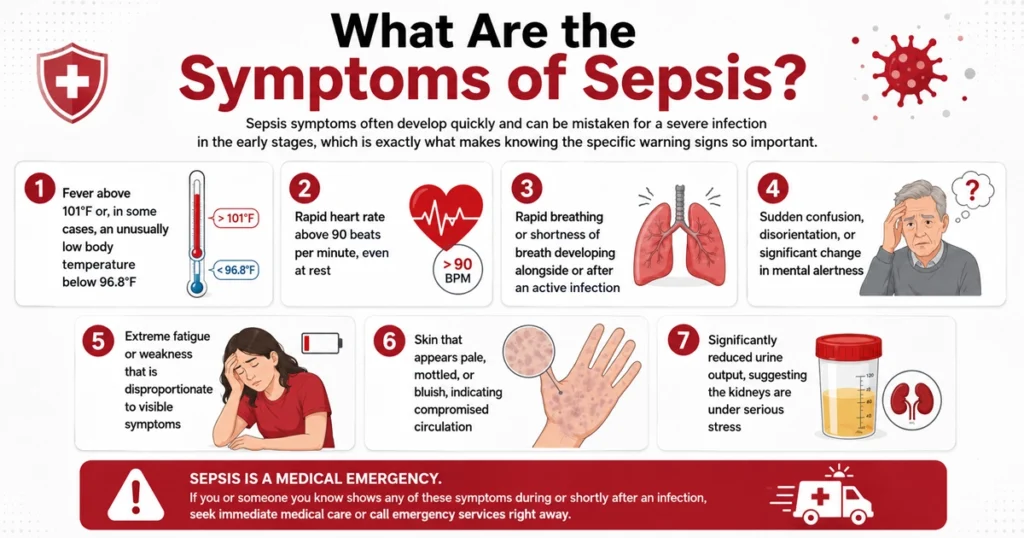
Sepsis symptoms often develop quickly and can be mistaken for a severe infection in the early stages, which is exactly what makes knowing the specific warning signs so important.
- Fever above 101°F or, in some cases, an unusually low body temperature below 96.8°F
- Rapid heart rate above 90 beats per minute, even at rest
- Rapid breathing or shortness of breath developing alongside or after an active infection
- Sudden confusion, disorientation, or significant change in mental alertness
- Extreme fatigue or weakness that is disproportionate to visible symptoms
- Skin that appears pale, mottled, or bluish, indicating compromised circulation
- Significantly reduced urine output, suggesting the kidneys are under serious stress
If you or a loved one experiences these warning signs, seek immediate medical attention. A hospital near me can provide prompt evaluation, testing, and treatment to help identify sepsis early and prevent life-threatening complications.
How Is Sepsis Treated?
Treatment for sepsis must begin immediately and almost always requires hospitalization and intensive medical support to stabilize the patient and prevent organ failure from advancing.
- IV antibiotics are administered as soon as sepsis is suspected to target the most likely bacterial sources before culture results confirm the specific organism.
- Fluid resuscitation helps restore blood volume and maintain adequate blood pressure and organ perfusion throughout the acute phase of treatment.
- Vasopressors are used when fluids alone cannot stabilize blood pressure in cases of severe sepsis or septic shock.
- Source control involves treating or removing the underlying infection through surgical drainage, targeted antibiotics, or removal of infected tissue when necessary.
When To Go To The ER
Sepsis deteriorates fast, and every hour of delay significantly worsens outcomes. Do not wait to see if symptoms improve if an active infection is accompanied by any of the following:
- Sudden confusion or altered mental status
- Fever above 103°F or an abnormally low temperature that does not respond to medication
- Rapid heart rate or labored breathing developing during an illness
- Pale, bluish, or mottled skin appearing alongside a fever
- Little or no urine output over several consecutive hours
Knowing the top reasons to go to the emergency room helps you act faster when these signs appear together. Visit the ER near me immediately. Neighbors Emergency Center provides 24/7 evaluation with rapid blood cultures, IV antibiotic therapy, and continuous organ monitoring for patients with suspected sepsis.
Sepsis Care At Neighbors Emergency Center
Sepsis can move from a concerning infection to life-threatening organ failure faster than most families expect, and having access to immediate emergency evaluation can make a significant difference in outcomes. With our 24/7 emergency room at Neighbors Emergency Center, our team is equipped to identify sepsis early, initiate treatment quickly, and monitor your condition throughout your care. Whether the infection started in the respiratory tract, urinary system, or skin, we provide fast and comprehensive emergency care for serious infections. Do not wait for warning signs to worsen.
Key Takeaways
- Sepsis is not contagious and cannot spread from one person to another under any circumstances
- Sepsis is the body’s extreme immune overreaction to an existing infection, not a transmissible disease
- Some infections that trigger sepsis, like strep throat and flu, can spread to others in close contact
- Older adults, infants, and people with chronic conditions face the highest risk of developing sepsis
- Sepsis progresses through three stages: sepsis, severe sepsis, and septic shock
- Immediate emergency evaluation when warning signs appear is the most important factor in survival